


Background and context
The glass manufacturing industry faces increasing pressure to reduce its environmental impact and its reliance on silica sand, which is extracted through energy‑intensive processes. At the same time, the UK metal casting sector generates around 200,000 tonnes of spent foundry sand (SFS) each year, much of which is sent to landfill.
Despite its high silica content, SFS is not currently used in glass manufacturing, due to concerns over operational risk, quality consistency, furnace performance, as well as supply chain integration and viable commercial models for recycling SFS.
About the Project
The Foundry to Furnace project was initiated to overcome these barriers through a cross‑sector feasibility study. Delivered under the Henry Royce Institute Industrial Collaboration Programme, the project brought together expertise from Glass Futures Ltd (GFL), Glass Technology Services Ltd (GTS), Omega Sinto Foundry Machinery Ltd (OSFML), the Cast Metals Federation (CMF), plus Royce teams at the Universities of Manchester and Sheffield.
Their objective was to assess the technical, economic, and environmental feasibility of upcycling SFS into glass products. The project identified practical pathways to transform an underused industrial waste stream into a new circular supply chain for UK foundation industries.
Project Details and Results
The project was structured into four interlinked work packages (WP1-4), conducting laboratory scale analysis and processing trials, alongside systems level economic and environmental modelling.
WP1: SFS Mapping
This activity defined the technical and logistical requirements that SFS must meet to be considered a viable secondary raw material for glass manufacturing.
In parallel, led by GFL with support from OSFML and the CMF, SFS generation and potential supply chain structures for the consolidation, processing, and treatment were mapped across the UK. Analysis demonstrated strong geographic overlap between SFS sources and glass manufacturing sites, particularly in northern England, indicating that logistics and proximity are not fundamental barriers.
WP2: Sand Analysis
With the aim to identify suitable SFS sources and define the level of material conditioning required to meet the specifications identified in WP1, GTS undertook chemical and physical characterisation of a representative range of SFS samples supplied by OSFML.
Analysis was conducted before and after processing using OSFML’s reclamation equipment, supported by X‑ray diffraction and CHNS elemental analysis commissioned by GFL at the Henry Royce Institute, Sheffield.
The analyses showed substantial variability in untreated SFS, highlighting a key challenge for glass producers, who rely on highly consistent raw materials. However, a number of appropriate sources of processed SFS were identified and selected for subsequent steps.
WP3: Techno‑Economic and Environmental Modelling
Led by GFL, a techno‑economic and environmental assessment was conducted on the sourcing, processing, and transporting of the selected SFS sources from WP2. The analysis benchmarked these against virgin and mined silica sand, incorporating high‑level carbon emissions and water consumption calculations.
In parallel, blending scenarios were evaluated to determine whether multiple SFS streams could be combined to dilute undesirable components while remaining within required impurity tolerances.
Overall, the analysis demonstrated that SFS recycling could potentially generate circa £10 million in turnover if recycled material replaces a proportion of virgin silica sand. These findings provide a strong commercial rationale for investment in dedicated recycling hubs. Meanwhile, the blending trials confirmed that processed SFS can meet the required impurity tolerances when combined with commercial silica sands.
WP4: Glass Trials
As the final stage of the feasibility study, trial melts were conducted by Glass Technology Services Ltd (GTS), to assess glass-making capability and the scalability of this processing route.
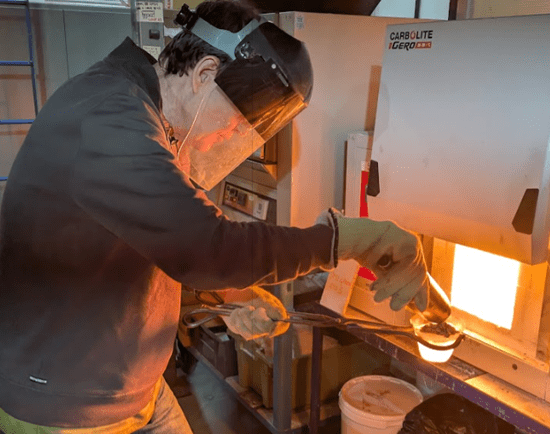
Based on performance against benchmarked plain glass sand, and identified materials availability from WP1, two forms of SFS were selected for large scale 40kg melt trials, utilising the HTMOS furnace at GTS. The resulting glass samples provided proof-of-concept to progress to pilot‑scale glass manufacture.
Overall, the study has indicated that processed SFS can provide a technically and commercially viable pathway to replace virgin sand with an underutilised waste stream for UK glass production.
Impact & Next Steps
The funding and collaborative framework that Royce’s ICP programme provided was crucial in convening partners from the glass manufacturing, metal casting, and academic research communities. The result was a focused study that integrated technical testing, techno‑economic and environmental analysis, and supply chain evaluation.
The project demonstrates that, with appropriate reclamation and impurity management, SFS can act as a technically and commercially viable substitute for virgin silica sand, delivering system‑level benefits including landfill diversion, reduced reliance on primary raw materials, and strengthened collaboration between two foundation industries.
If implemented at scale, this approach could divert up to 200,000 tonnes of waste from landfill and support a £10m recycling market.
The study has highlighted the need for further extended pilot and industrial‑scale trials, refinement of impurity control and quality assurance strategies, and the development of commercially robust recycling hubs and supply contracts.
Collaborators
This feasibility study evaluated the potential to validate the use of spent foundry sand (SFS) from the UK’s metal casting industry in glass manufacturing. With appropriate reclamation and supply chain models, it was determined that SFS can be technically integrated into glass production and offers strong potential economic and environmental benefits.
"By combining detailed chemical analysis of spent foundry sand with techno-economic modelling of processing and logistics, this project showed that recycled sand could become a viable secondary raw material for glass manufacture under the right processing and supply chain conditions. This could redirect over 100,000 tons of waste per annum from landfill and improve resource efficiency across the cast metals and glass sectors."
Lorraine Ferris, Henry Royce Fellow
Henry Royce Institute, University of Manchester