



A National Framework for Materials 4.0: Pathways to Implementation
About the Materials 4.0 National Framework
Materials 4.0 refers to the creation of a connected “digital thread” through materials innovation processes, linking data, models, digital infrastructure and operational tools so that materials can be designed, tested, manufactured and recovered more efficiently and with greater confidence.
The report highlights that this capability is now essential to achieving national priorities at the required pace across net zero, clean energy, defence, nuclear resilience, battery supply chains and advanced manufacturing.
The findings show that fragmented and inaccessible data remains one of the biggest barriers to innovation. Valuable materials data is often locked in legacy systems, poorly described, or difficult to exchange between organisations. This slows product development, increases costs and creates unnecessary duplication across supply chains.
By contrast, better data and interoperable digital tools can deliver significant economic and strategic benefits, including faster development cycles, reduced waste, improved compliance and traceability, stronger supply chain resilience, and higher-value circular recovery of materials at end of life.
Read the Executive Briefing
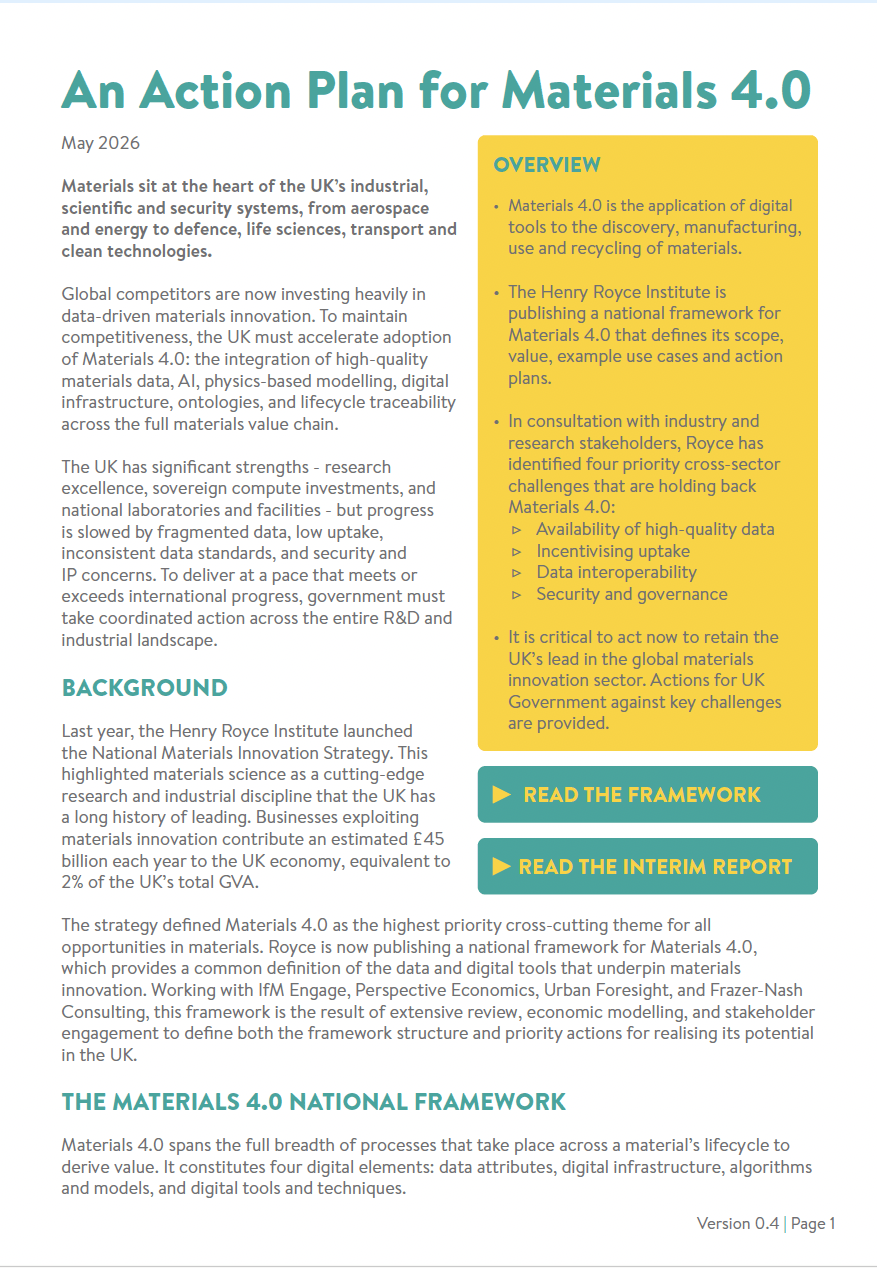
This summary document introduces the Henry Royce Institute’s Materials 4.0 National Framework and concisely outlines the priority actions needed to accelerate its adoption across the UK.
It explains the strategic value of Materials 4.0, including the use of high-quality data, AI, modelling, digital infrastructure and lifecycle traceability across the materials value chain, alongside the background and context of digitalisation in the UK.
The document identifies four cross-sector challenges holding back progress: data availability, uptake, interoperability, and security and governance. It also sets out practical solutions and recommended actions for UK Government to help strengthen national competitiveness, industrial resilience and scientific leadership in advanced materials.
Read the Interim Report in Full
This interim report introduces the early development of the Henry Royce Institute’s Materials 4.0 National Framework, which has since been iterated into the final version. It remains a valuable supporting document, setting out the original scope of the framework and providing detailed evidence on the UK Materials 4.0 landscape.
Drawing on stakeholder interviews, research and innovation mapping, and international benchmarking, it explains how data attributes, digital infrastructure, algorithms, models, tools and techniques can support innovation across the full materials value chain. The report also highlights use cases, UK capability, global comparators and opportunities for future development.
Four priority areas for national delivery
The report identifies four priority areas where coordinated action is needed to build a national Materials 4.0 capability.
How Materials 4.0 supports UK industrial and research priorities
The report responds directly to one of the core cross-cutting priorities identified in the National Materials Innovation Strategy: ensuring the UK’s materials sector is digitally enabled, globally competitive and resilient.
It also aligns with wider national strategy objectives linked to artificial intelligence, compute infrastructure, batteries, critical minerals, advanced manufacturing and science-led economic growth.
The commercial significance of Materials 4.0 is clearly conveyed in high demand for materials-related research and innovation projects, of which there were nearly 6,000 since 2005.
By supporting the development of FAIR materials data — data that is findable, accessible, interoperable and reusable — Materials 4.0 can help ensure that national investments in AI, digital infrastructure and materials innovation deliver long-term value for UK industry and research.


“The UK has world-leading expertise in materials science and growing strength in AI and digital infrastructure. Our challenge now is to connect those strengths through trusted data, shared standards and coordinated investment. By doing so, we can create a true digital thread across the materials lifecycle, reducing cost, improving sustainability and securing long-term competitive advantage for UK industry"
Professor David Knowles, Royce CEO
Looking ahead
As the UK works to deliver economic growth, net zero and technological sovereignty, Materials 4.0 will be a critical enabler of future industrial prosperity.
The Henry Royce Institute will continue to convene partners across government, industry and academia to champion the investment, partnerships and skills needed to deliver this national framework and ensure the UK is positioned to lead in the next era of materials innovation.