



Matcelerate
ZERO

MATcelerate ZERO is a translational funding programme offering a pathway for university researchers to translate their net-zero materials innovations into market-ready solutions.

Apply for Funding

Overview

MATcelerate ZERO is delivering a pipeline of de-risked innovative materials to industry from the groundbreaking innovations being developed within UK universities.

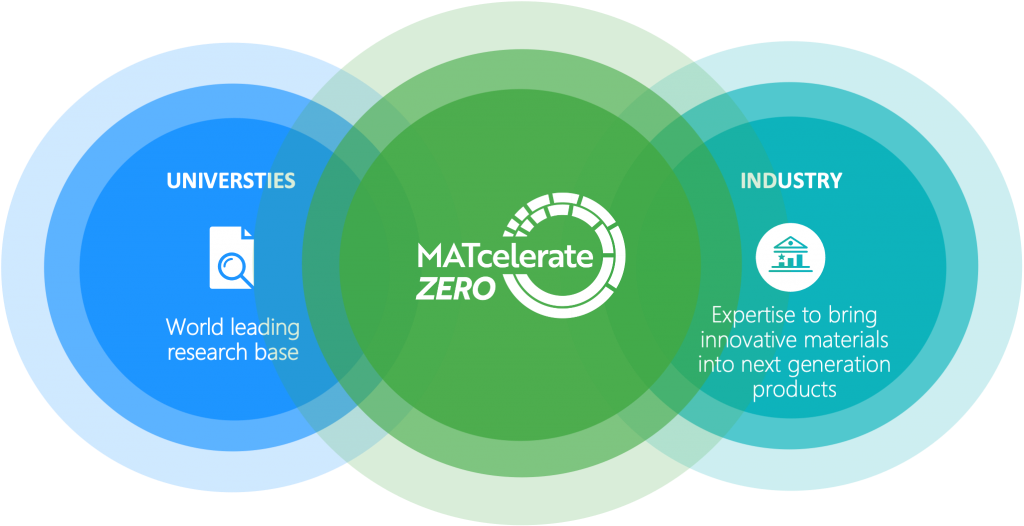
MATcelerate ZERO consists of six of the most materials research intensive and active universities in the commercialisation sphere, the Henry Royce Institute, and a growing number of industry partners with the goal of developing climate solutions to achieve the transition to net-zero.

By leveraging this collaborative model MATcelerate ZERO is addressing sector-wide integration and scale up challenges to turn materials into next generation products, reducing lab to market timescales for new materials from 20-30 to 7-10 years.

Our Approach

The programme provides innovators with a new route to find industry partners, while also giving corporate partners first refusal on licensing de-risked intellectual property.

Industry partners work with university technology transfer offices to define and select projects to receive funding from a central fund to which they contribute, in exchange for facilitated, preferential access to the new innovative opportunities and options to commercialise.
MATcelerate ZERO is based on a proven model, led by Cambridge Enterprise, to address similar integration and scale-up challenges in the pharmaceutical and agritech sectors.

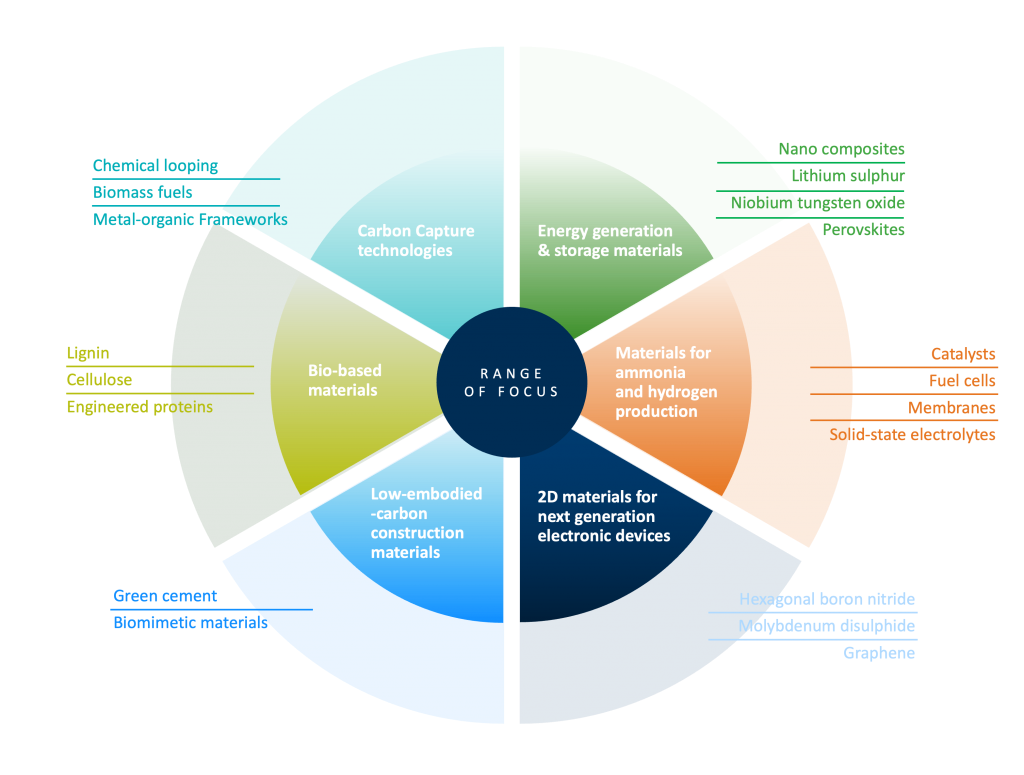
Range of Focus

University Partners

CAMBRIDGE ENTERPRISE

Cambridge Enterprise is responsible for supporting the translation of University of Cambridge research to create globally leading social and economic impact. Managing investments made by the University of Cambridge Venture Fund, we have invested over £43 million in more than 158 companies across a wide range of sectors, with portfolio companies together going on to raise over £3.7 billion in follow-on funding since 1995. Notable spin-outs include natural materials-based alternatives to plastics B-Corp Xampla, high-power ultrafast-charging battery technology company Nyobolt and sustainable power electronics solutions firm Cambridge GaN Devices.

MANCHESTER INNOVATION FACTORY

The University of Manchester Innovation Factory has been responsible for over 60 spinouts, including thirteen in the last year. It has recently made record annual licensing income (£7.4m) and closed the University’s largest ever IP licensing deal ($88m). Within the last 12 months investment in spinout companies also increased with £3.6 m of external investment being made in new spinouts, along with £41m of external investment in existing spinout companies.

OXFORD UNIVERSITY INNOVATION

Oxford University Innovation is the research commercialisation arm of Oxford University, supporting innovation and entrepreneurial activities across all University Divisions. We are helping the University to create a world-leading innovation ecosystem with Oxford University at its heart. Oxford University Innovation is the highest university patent filer in the UK and is ranked 1st in the UK for university spinouts, having created over 200 new companies since 1998.

UNIVERSITY OF LEEDS

The University of Leeds has a strong history of converting cutting edge research and innovation into successful commercial ventures, recognised through its standing in the top (5th) quintile of KEF5. To date we have launched over 150 spinout companies (with 43 in our current portfolio). In 2024 these companies employed over 1,400 people, generated a turnover of £137 million, and attracted new investments totalling £51 million. Notable recent spinouts include Cavero Quantum, pioneering groundbreaking cyber-security technology to combat cyber-attacks, and Microlub, who have developed transformational protein technology for fat replacement.

OXFORD BROOKES UNIVERSITY

Oxford Brookes University has a diverse and driven approach to reaching net-zero. In particular, it houses the Oxford Institute for Sustainable Development, one of the UK’s largest research institutes dedicated to sustainable development research in the built and natural environments. Brookes’ Technology Transfer Office supports researchers in all schools, from engineering to nutrition to business, helping them increase the socioeconomic impact of their research. Brookes leads the way for commercialisation income in post-92 universities, with over £20 million in licensing income over the last three years.

WARWICK INNOVATION DISTRICT

Warwick Innovations is the commercialisation arm of the University of Warwick, helping world-class research achieve real-world impact. We work with academics, industry, and investors to identify opportunities, protect intellectual property, and translate discoveries into scalable technologies. Through spin-out creation, licensing, and strategic partnerships, we accelerate the adoption of new materials and manufacturing innovations. As part of MATcelerate ZERO, Warwick Innovations contributes its expertise in technology transfer and venture development to drive sustainable, high-impact collaborations across the UK’s materials community.

BRISTOL INNOVATIONS

The University of Bristol is fifth in the UK for research excellence with 94% of its research assessed as world-leading or internationally excellent. From this research base, the University has an increasing reputation for innovation and delivering impact. In the last three years, the current portfolio of 74 active spin out companies – covering areas as diverse as gene therapies, medical devices, advanced materials and testing, quantum technologies, AI and security – raised over £1.1bn in external investment. A notable exit has been the acquisition of synthetic chemistry spin out Ziylo by global healthcare company Novo Nordisk in a deal worth up to $800 million.

IMPERIAL COLLEGE LONDON

The Enterprise division of Imperial College London has been responsible for 290 staff and student startups from 2017 to 2022 and these companies have raised £609 million in external funding. Notable startups include ContextAI, Myricx, NK:IO, ProtonDx, Qaisr, Solena Materials, Biocentis, Permia Sensing, Toffee AM, Notpla, Fluus, Puraffinity, Gravity Sketch, Charco Neurotech, Multus, Fresh Check, Jelly Drops, Deploy Tech, Recycle Eye, Koalaa, Magdrive, Humanising Autonomy, Materialise X, and Petit Pli.

UNIVERSITY COLLEGE LONDON

UCL is currently involved with 75 active spinouts and has been responsible for raising £1.4b in external investment in the last 3 years. Within the last 12 months there have been significant exits from engineering spinouts Senceive Ltd (www.senceive.com) and Satalia (https://www.satalia.com/) following their acquisition by EddyfiNDT and WPP respectively. Also, Bramble Energy, a fuel cell spinout that manufactures PCB fuel cell stacks and systems recently raised a £35m investment round.

UNIVERSITY OF LIVERPOOL

The University of Liverpool Enterprise Team has been responsible for 24 spinouts in the last 6 years, creating over 130 jobs, bringing over £18m of external investment into spinouts (since 2014) and over £23m in IP related income to the University (since 2018). Over the past year, we have made impressive progress in executing the University enterprise strategy, with visible benefits from our investments in capabilities and partnerships to support spin-out growth and the wider enterprise ecosystem within the University of Liverpool.

UNIVERSITY OF SALFORD

The University of Salford achieves a level of spin-out activity despite its size, driven by a culture of impactful research and a collaborative approach. A healthy appetite for risk allows the institution to pursue bold opportunities, supporting innovative ideas at an early stage. Salford also benefits from a less bureaucratic decision-making process, enabling faster responses and greater agility when moving projects from concept to commercialisation. Strong internal connections between the Technology Transfer Office (TTO) and our academic and research community creates a tightly woven ecosystem where ideas and expertise can be shared seamlessly. This collaborative environment ensures that promising innovations can be identified, nurtured, and advanced. Externally, Salford leverages robust networks across the knowledge exchange and commercialisation community, both regionally and nationally. These partnerships can provide access to investment, mentorship, and markets, amplifying the university’s capacity to transform research into spin-out ventures

UNIVERSITY OF SHEFFIELD

The Commercialisation Team at the University of Sheffield is the driving force behind the university’s Commercialisation Journey, a structured programme designed to translate research into high-potential spinout companies and licensing opportunities.

Join the Collaboration

We want to work with globally-leading materials companies that are committed to innovating to achieve their net zero goals and want to develop strong links to materials intensive research institutions in UK

Learn More
Privacy Overview

This website uses cookies so that we can provide you with the best user experience possible. Cookie information is stored in your browser and performs functions such as recognising you when you return to our website and helping our team to understand which sections of the website you find most interesting and useful.