


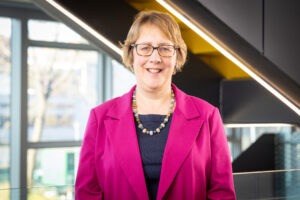
Ahead of the Royce National PhD Conference taking place this week, we sat down with Dr Laura Cohen, Royal Academy of Engineering Visiting Professor at Royce and University of Manchester and Former Chief Executive of the British Ceramic Confederation. Laura’s PhD conference presentation will cover Materials Science policy, and she will also be on a careers panel, so we asked her about her policy career and what advice she would give to PhD students with ambitions to enter the policy sphere.
What were your first steps into policy or engagement?
I didn’t move into policy straight after my PhD. After more than a decade working in the chemical and pharmaceutical industry I spent several years at AstraZeneca as an international packaging project manager, working across marketing, regulators, suppliers and manufacturing. I was introducing new products including a nasal spray, but unlike many colleagues, I didn’t have a long background in packaging, so I attended what was then the Institute of Packaging Pharmaceutical Forum for some professional development, and I eventually became its Chair.
At the same time, new European packaging legislation was emerging, so I helped shift what was a very technical group into one that could understand and influence legislation, working closely with trade associations and regulators. I led the company’s project on implementing Braille on medicine packaging, worked on UK and European standards groups, and learned how to balance stakeholder needs and manufacturing constraints. Consistent implementation across Europe even saved the company around €15 million.
My work led the Association of British Pharmaceutical Industry to nominate me to a UK Better Regulation Task Force with the Cabinet Office and the Medicines and Healthcare products Regulatory Agency, which enabled industry self‑certification for many leaflet updates.
Later, I pushed for the creation of a packaging regulatory intelligence role in my company and helped establish a European packaging group through the European Federation of Pharmaceutical Industries and Associations. All of this helped me build the influencing, consensus‑building and legislative understanding that ultimately enabled my move into policy.
What’s the biggest misconception PhD students have about working in policy, government, or the not-for-profit sector?
You don’t necessarily need to have studied politics to have a policy career!
There are indeed plenty of people who’ve done degrees in politics who work in think tanks, the civil service and in trade associations, but the policy space needs all sorts of people with different backgrounds working in it, including scientists and engineers, who can contribute massively because they bring many different skills.
Do you need to be “political” to work in policy, and what does that actually mean in practice?
I think in any role, whether it’s in a university or in industry, there’s going to be “politics”, as in how an organisation works, understanding the organisational agenda and how to influence that environment. But in policy roles, you’ll also need to analyse what government’s priorities are and how your work and your stakeholders’ work factor into those. It’s about understanding organisational and stakeholder needs, what problems need to be solved, generating, analysing, costing and prioritising options with advantages and disadvantages and communicating these.
If a current PhD student wants to move into policy, what should they start doing now?
First of all, keep up with current affairs and understand its significance on your PhD, as well as the wider economy and how this might affect the priorities of potential employers. I think the second area is to understand the context of your PhD against a policy and regulatory background. This includes starting to understand your PhD studies from the perspective of how it could benefit the country’s prosperity and growth.
Also, speak to supervisors and other staff in your department about policy work as they or their students may have done work in that space and can offer their perspective and advise you.
Specific University experiences that can really help are volunteering in outreach activities, participating in organising clubs, societies and committees and student representation roles; these can teach you so much more about how organisations and teams work effectively and how to influence outcomes. They also provide useful transferable skills for many other roles.
Building networks is also really beneficial. Keep an eye on what your careers service is doing, because there could be, for example, visits of the civil service fast streams to a careers fair. If your work is funded by a Government/UKRI programme, then there may be opportunities to speak to UKRI staff about the broader context of those funding programmes. There may be opportunities such as secondments and short-term internships for trade associations, think tanks and even MP shadowing for short periods if you reach out and enquire.
Should PhD students be engaging with policy during their research, and if so, how?
I’m aware that some research groups at Manchester already engage in the policy space, such as Sustainable Futures. If your university has a policy group such as Policy@Manchester as they will likely have events throughout the year that you can attend, e.g. talks by regulators. You might also have the opportunity to contribute to responses for government consultations if you have relevant expertise in that area, provided you have the support of your supervisor, and if necessary, head of department and sponsor to do so.
What does a “typical” entry-level role in policy look like?
Many entry-level roles would be in the civil service policy or science and engineering fast stream and it’s about building your leadership skills from there. Typical activities would include policy development (gathering and analysing data and working out the implications, gathering and incorporating feedback), or briefings to senior officials or ministers, attending meetings with officials or politicians to explore emerging policy areas, organising and minuting meetings with stakeholders.
Which skills gained from PhD study would be most valuable in policy or engagement careers?
Clear Communication skills – written and verbal – are essential for speaking to different audiences, including non-experts. Distilling information in a clear concise way, such as ‘elevator pitches’ is also vital. Other important skills include objective, solid and rapid analysis, spotting trends, outliers and key pieces of data, understanding the context and benefit of your work, and strong project management.
Also look out for what Royce organises throughout the year such as events and training which help build up a range of skills and opportunities to network. Technical and entrepreneurial skills all help build a solid foundation for your career, whichever way you may go.