


Overview
This workshop brings together the XPS user community to develop skills in reviewing, interpreting, analysing, and presenting XPS data. Fundamental principles are introduced through hands-on work with progressively more complex real-world datasets, alongside guidance on best-practice methodologies. Example applications will cover a range of materials, including organics, semiconductors, and transition metals.
Members of the XPS technical team will lead practical sessions, explaining the underlying physics that informs accurate analysis and guiding participants through the full workflow, from data acquisition to interpretation and reporting.
Date: 04-06 Nov 2026
Format: In-person
Location: Henry Royce Institute, Royce Hub Building, University of Manchester
Background and motivation
XPS provides quantified elemental and chemical state (atomic bonding) information from the surface and is used ubiquitously across advanced materials research. However, analysis of XPS data can be complex, often requiring detailed knowledge of the physical processes taking place to correctly interpret findings. This workshop aims to assist users in understanding how to best approach their own data through shared examples and investigation, through:
- Introducing the different variations and applications of XPS as a technique and outline the breadth of facilities available.
- Detailing the physical principles of the X-ray photoemission process.
- Training users in how to interpret and analyse spectra.
- Training users in learning to recognise what good data looks like and to critically assess XPS data in the literature.
Audience
The workshop is aimed at PhD students, technical and research staff who are making use of the XPS facilities at Manchester or through Royce in support of their research.
Workshop participants will need to bring their own laptop to fully participate in the workshop. A list of software and data required for the practical will be provided after registering.
Learning outcomes
- An appreciation of what information XPS can provide, its limitations, and how the different variations of the technique could be used to answer different questions.
- An understanding of the fundamental physics involved in the photoemission process, which then informs appropriate decomposition of XP spectra.
- An understanding of how to use CasaXPS to process, quantify, peak fit, and export XPS data.
- An understanding of the challenges in decomposing spectra and how that might impact the conclusions drawn from the analysis.
- An understanding of the where to find reliable data when processing XPS data, and insight into the variable accuracy of XPS interpretation in the wider literature.
Programme
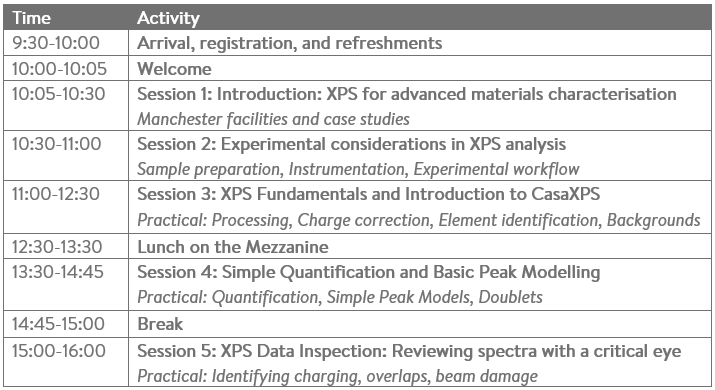
Day 1
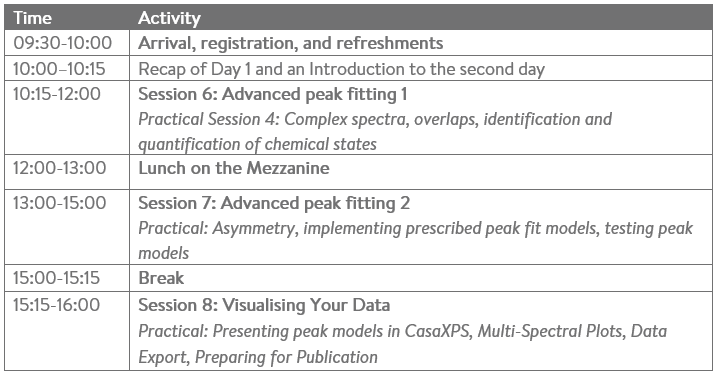
Day 2
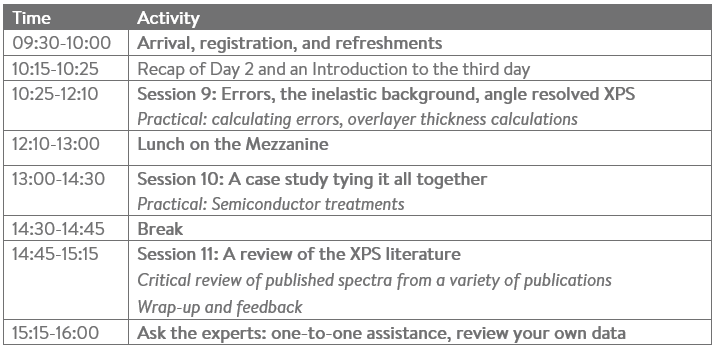
Day 3
Organisers
- Andrea Izquierdo – Royce
- Ben Spencer – The University of Manchester
- Marek Nikiel – The University of Manchester
- Liam Dwyer – The University of Manchester
- Sramana Kundu – The University of Manchester
November 6 2026